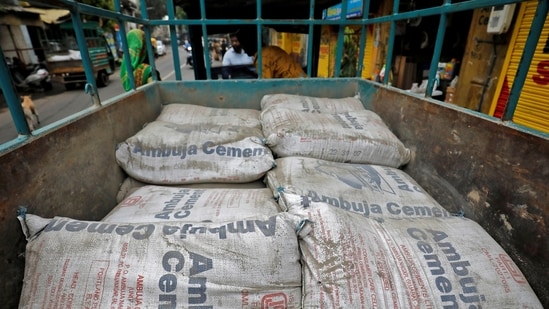
Billionaire Gautam Adani is folding his cement empire into one single entity, in what is seen as an attempt to streamline operations and take on market leader UltraTech Cement Ltd. in India’s rapidly consolidating infrastructure space.
The board of Ambuja Cements Ltd. has approved the merger of ACC Ltd. and Orient Cement Ltd. with the flagship Adani Cements company, according to an exchange filing on Monday, 22 December 2025. The deal creates a so-called “One Cement” platform to eliminate the corporate overlap that has been prevalent since Adani Group acquired Holcim AG’s India assets in 2022.
- The merger also includes Sanghi Industries and Penna Cement, regional cement firms acquired recently.
- Post-merger, Adani Group’s stake in Ambuja Cements will dilute to 60.94% from 67.65% at present.
- Post-merger, Ambuja and ACC will continue to operate independently.
The idea is to unlock synergies in manufacturing and logistics, optimise cost related to sales and marketing, and strengthen the balance sheet by improving margin by up to ₹100 per metric tonne.
“This consolidation represents a transformational step in building a globally competitive, integrated cement and building materials organisation,” Karan Adani, non-executive director at Ambuja Cements, said in a statement. The unified balance sheet, according to him, would provide the “resilience” needed to accelerate capacity expansion.
Ambuja Cements vs UltraTech Cement
Adani Group’s Ambuja Cements is locked in a high-stakes arms race with Aditya Birla Group’s UltraTech Cement. Both the companies are snapping up regional players for a bigger play in India’s infrastructure overdrive.
Over the last couple of years,
- Ambuja Cements has acquired Sanghi Industries (December 2023), Penna Cement Industries (August 2024) and Orient Cement (March 2025).
- UltraTech Cement acquired The India Cements Ltd. in late 2024 and Kesoram Industries Ltd. in early 2025.
The terms of the Ambuja Cements merger
The three-way merger effectively removes the dual-listed structure of Ambuja Cements and ACC—a vestige of the Holcim era.
- ACC shareholders will receive 328 Ambuja shares for every 100 shares held.
- Orient Cement shareholders will receive 33 shares for every 100 held.
“The swap ratio with ACC largely remains on a par with closing market price while it offers a ~9% premium for minority shareholders of Orient Cement,” JM Financial said in a note dated 23 December. “That said, further simplification of the group structure…should enhance transparency and governance standards, which we view as sentimentally positive for the stock.”
The merger, likely to be completed in the next 12 months, is unlikely to attract scrunity of the Competition Commission of India since it’s between subsidiary and parent firm. Approvals from the National Company Law Tribunal and shareholders are needed.
The “appointed date” for the ACC merger is set for 1 January 2026 while that for Orient Cement is retrospective to 1 May 2025.
The financial potential of the Ambuja merger
The financial rationale centres on synergies across the supply chain.
- By integrating Orient Cement’s high-quality limestone reserves and ACC’s vast distribution network, Ambuja Cements expects to significantly lower its cost of production.
- The management estimates cost synergies of at least ₹100/tonne with aid in achieving the group’s targeted cost, margin and growth objectives.
- Ambuja Cements is targeting total production capacity of 118 million tonnes per annum by FY26, 130-135 MTPA by FY27, and 155 MTPA by FY28 as against 140 MTPA earlier.
The unified entity will continue to market as ‘Adani Ambuja’ and ‘Adani ACC’ brands. While the corporate structure is being flattened, Adani Group aims to maintain brand equity of each label. Moreover, ACC as a standalone brand enjoys state-level incentives in various states.
The merger was advised by Cyril Amarchand Mangaldas, as well as IDBI Capital Markets and SBI Capital Markets.