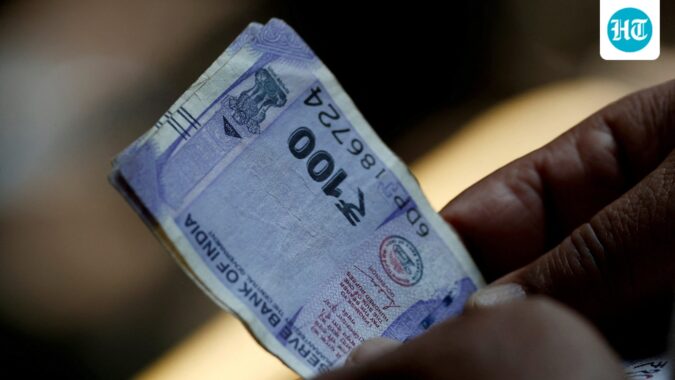
Amid the delays of a trade deal between India and the United States, the Indian rupee continues the weaken and reached a record low of ₹90 per US Dollar (USD) on Wednesday, December 3.
On Wednesday morning, the rupee weakened to a low of 90.13 for one US Dollar, hitting below its previous all-time low of 89.9475 on Tuesday. As of 8:04 AM UTC, the Indian rupee stands at ₹90.26 against one dollar.
The Indian rupee has already been named as one of the worst forex performers for 2025, reported AFP news agency.
What has led to the massive fall?
As per analysts, the weakening of the rupee comes as the trade deal between India and the US stays in limbo.
Dilip Parmar, an analyst at HDFC Securities, said that rupee’s fall was “first and foremost” an “imbalance of demand and supply” with foreign fund outflows and trade deal uncertainty adding more problems, AFP reported.
Another key factor, the analyst added, was the lack of intervention from the Reserve Bank of India.
Also Read | Rupee risks steeper fall past 90/Dollar without RBI help, India-US trade deal
The news agency quoted analysts stating that the central bank this year has sporadically defended the rupee through aggressive dollar sales to support key levels, but has also allowed greater currency flexibility.
“With inflation running well below earlier expectations, the policy priority has shifted toward supporting growth rather than expending reserves to hold an artificial line,” Raj Gaikar, research analyst at SAMCO Securities was quoted as saying.
Joey Chew, head of Asia FX research at HSBC in Singapore, told Reuters that the delay in the trade deal remains a key reason for the weakened rupee.
“Every day that we do not have a trade deal, the FX demand from trade deficit and outflows keeps pushing USD/INR higher, while FX supply is relatively thin and inconsistent,” said Chew.
“Foreign investors are also losing patience. We had one month of net inflows in October, but without any more trade deal headlines since then, net flows have become flat,” she added.
Not losing sleep over weakening rupee, says CEC
Amid the worry caused by the weakening of the rupee, India’s Chief Economic Adviser V. Anantha Nageswaran has stated that the fall of the rupee is not a major worry.
Speaking at a press conference on Wednesday, he added that the weakening of the rupee will not impact inflation and exports.
He added that Washington may also scrap the additional tariff against India.
“My personal confidence is that in the next couple of months, if not earlier, we will see a resolution to at least to the extra penal tariff of 25%,” Nageswaran said at a event in Kolkata.
“It may also be the case that reciprocal tariff of 25% may also come down to levels, which we were earlier anticipating somewhere between 10% and 15%,” he was quoted as saying by Reuters.
(With inputs from Reuters, AFP)